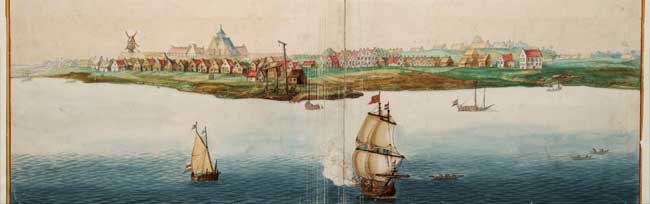
The September 2009 issue of National Geographic Magazine had a fascinating article about Manhattan before it was settled. The article is based on the work of the Manahatta Project, an endeavor to match the current city to the terrain as it existed prior to settlement by Europeans and to then add the ecosystem that went with the land. The science of landscape ecology and the visualization of biosystem relations that the project has dubbed “Muir Webs” both appear to me to be narratives that go beyond single dimensions and instead look at the patterns formed.
For much the same reason, there is a similar narrative about the early settlers of New Amsterdam, among them is the story of my ancestor Jan Jansen van Flensburg. As a baker who came to the New Netherlands and raised his children in New Amsterdam, the records are far more extensive than for many other immigrants of that time and the maps well detailed (such as this 1656 map of the New Netherlands).
Seeing new ways of combining various data the way the Manahatta Project has done inspires me to look at new ways to bring together historical data and maps such that they tell a story that’s richer than the sum of their parts. A good start in this way of looking at information is the software from TimeGlider, which is useful in putting together historical events in sequence such as this history of World War I. [Update 01-12-2021:Â Timeline is now defunct, but I think offerings like Preceden and Twile include similar options).